How a Giant Star Swallowed Its Companion and Exploded
How a Giant Star Swallowed Its Companion and Exploded
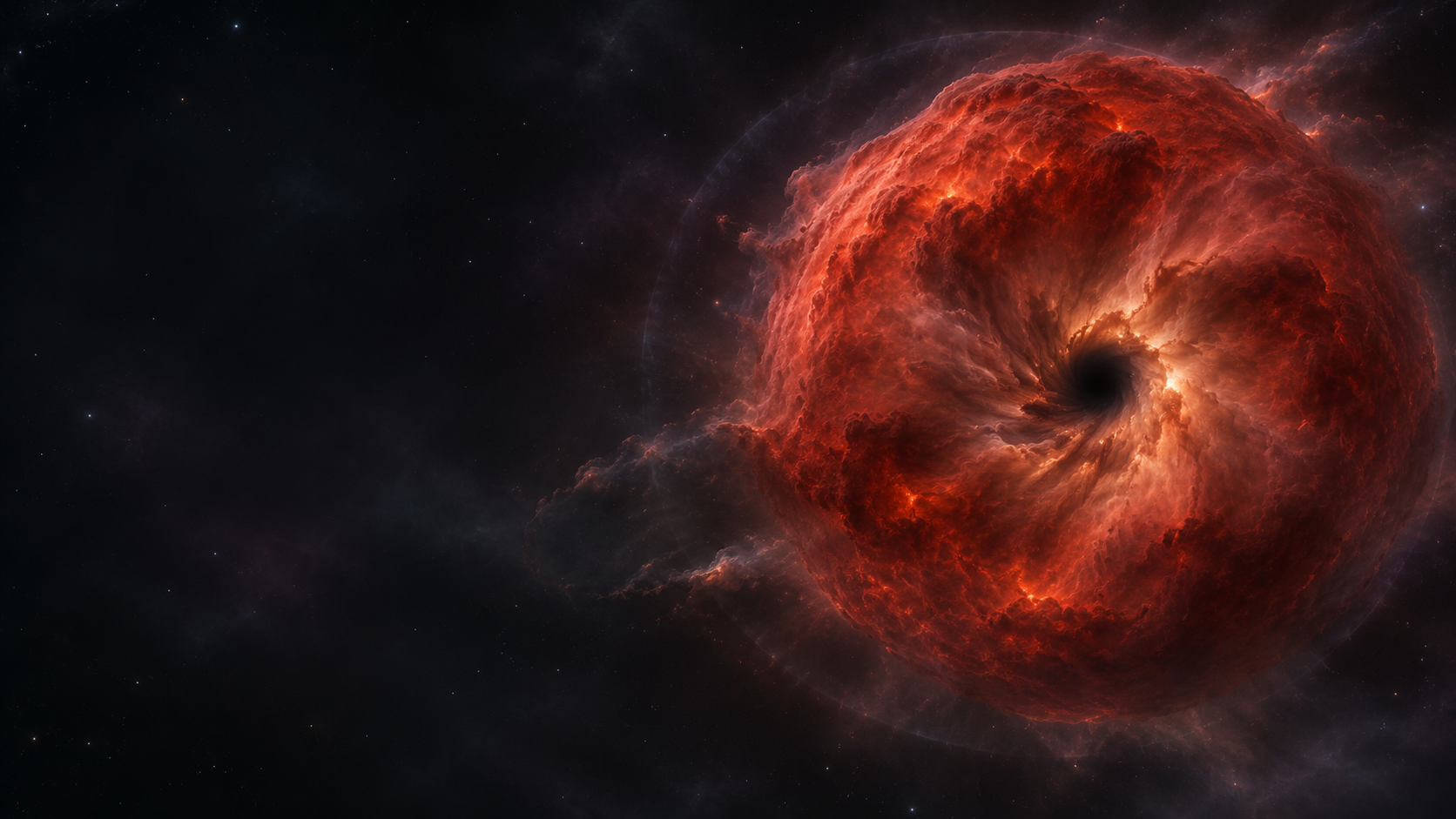
A giant star can appear to consume its companion, brighten dramatically, and erupt in a powerful cosmic explosion. The event may not be a conventional supernova. Instead, astronomers may be witnessing a stellar merger: two stars spiraling together until one becomes embedded in the other’s outer layers and the pair ultimately forms a new object.
These events are among the most dramatic episodes in the life of a binary star system. They can produce a temporary explosion called a red nova, release clouds of gas and dust, and transform two separate stars into one rapidly rotating stellar remnant.
“Giant star swallowed its neighbor” is an accessible description rather than a literal one. Scientifically, the process involves mass transfer, orbital decay, friction, energy release, and possibly the merger of two stellar cores. Observations of brightness, spectra, infrared emission, and expanding debris allow astronomers to reconstruct what happened, even when the stars themselves remain hidden.
A well-studied example is V1309 Scorpii. Before its 2008 outburst, observations showed the system’s two stars moving toward an eventual merger. The system then produced a luminous red nova, providing important evidence that stellar mergers can be observed as they occur rather than inferred only from their remnants. Source 1
What Does It Mean for a Star to Swallow Its Neighbor?
The Role of Binary-Star Systems
Many stars exist in pairs. The two stars orbit a shared center of mass, sometimes separated by millions or billions of kilometers. Their evolution depends not only on their individual masses but also on their distance from each other.
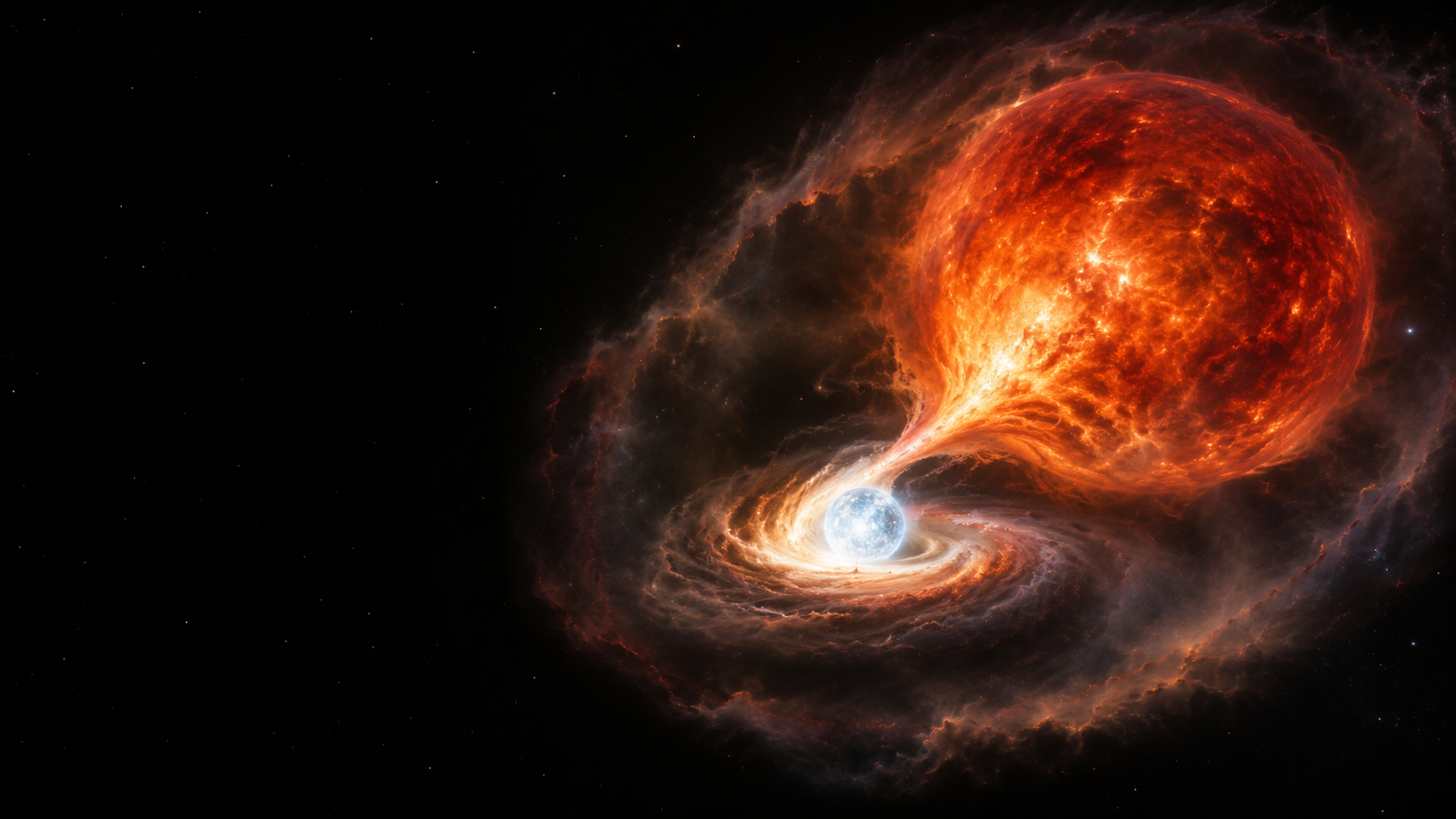
A star does not literally digest another star. “Swallowed” means that one star’s expanding outer atmosphere surrounds its companion. Gas can then flow between the stars, while friction inside the shared atmosphere removes orbital energy.
The larger or more evolved star can expand until it fills a region called its Roche lobe. This is the volume around a star where its gravity controls nearby material. Once the star exceeds this region, gas can flow toward the companion through a gravitational balance point between the two stars.
At first, this transfer may be relatively stable. Over time, however, it can become unstable. The donor star may continue expanding, while the companion may be unable to accept material quickly enough. The distance between the stars can shrink, accelerating the interaction.
How a Common Envelope Forms
In an advanced stage, both stellar cores can become surrounded by a shared cloud of gas. Astronomers call this a common-envelope phase.
The companion moves through the larger star’s outer layers. Friction slows its orbit and converts orbital energy into heat. As the companion spirals inward, the surrounding envelope can become brighter, hotter, and more energetic.
Several outcomes are possible:
- The envelope may be expelled into space.
- The two cores may merge.
- The system may produce a luminous red nova.
- The remnant may continue evolving toward a later supernova.
- The stars may avoid merging and form a tighter binary system.
The companion can lose its separate identity inside the common envelope without being immediately destroyed. Its core may survive for a time while its outer layers are stripped away.
Why “Swallowed” Is a Simplified Description
Astronomers distinguish among several related processes:
- Mass transfer: Gas moves from one star to the other.
- Envelopment: One star’s atmosphere surrounds its companion.
- Orbital decay: The companion spirals inward.
- Core merger: The stellar interiors combine.
- Envelope ejection: Gas is expelled into space.
A bright outburst may reveal only the combined light from the system. Astronomers must therefore use multiple observations to determine whether the event involved a complete merger, a temporary common envelope, or a surviving compact companion.
How Astronomers Observe a Stellar Merger
Changes in Brightness
Modern sky surveys repeatedly photograph large regions of the sky, creating long records of how stars change over time. A stellar merger may appear first as a gradual increase in brightness, followed by a sharp outburst and a long decline.
A typical light curve may show these stages:
- The stars brighten as mass transfer intensifies.
- The orbit shrinks and friction increases.
- The merger produces a rapid optical outburst.
- Expanding gas and dust cool the system.
- Visible light fades while infrared emission continues.
This pattern differs from many ordinary variable stars, which brighten and fade in regular cycles. It also differs from a classical supernova, whose light curve and spectral evolution generally reflect nuclear energy released during the destruction or collapse of a star.
The pre-outburst light curve can be especially valuable. In the case of V1309 Scorpii, archived observations showed a shortening orbital period before the eruption. This behavior supported the interpretation that the binary system was approaching merger. Source 2
Spectroscopy Reveals Expanding Debris
Spectroscopy separates light into its component wavelengths. Each chemical element leaves characteristic signatures, while shifts in those signatures reveal how fast gas is moving.
Doppler shifts show whether material is moving toward or away from Earth. Broad spectral lines usually indicate fast-moving gas, while narrow lines can come from slower material surrounding the system.
Astronomers look for:
- Hydrogen and helium emission lines.
- Absorption lines from cooler layers.
- Broad features caused by rapidly expanding ejecta.
- Narrow lines from older, slower gas.
- Changes in line strength as different layers become visible.
Spectra can change substantially during a merger. Early observations may show hot material close to the stars. Later observations can reveal cooler gas, dust formation, and nebular structures farther from the central remnant.
Infrared Observations Reveal Hidden Dust
A merger can produce large amounts of dust. Dust absorbs visible light and reradiates the energy at infrared wavelengths. The visible explosion may therefore fade while the infrared signal remains strong.
Infrared telescopes can detect newly formed dust grains, cool expanding ejecta, gas surrounding the merged star, and a central remnant hidden behind an opaque shell. The James Webb Space Telescope is designed to study faint infrared emission from distant astronomical objects, although the appropriate observatory depends on the event’s distance, brightness, and location. Source 3
Multiwavelength and Time-Domain Astronomy
No single observation can usually explain a stellar merger. Astronomers combine data from optical telescopes, infrared observatories, radio instruments, ultraviolet telescopes, X-ray facilities, and wide-field survey cameras.
This approach belongs to time-domain astronomy, the study of objects that change over time. A merger is not a fixed target: its brightness, temperature, chemical signatures, and shape evolve from day to day, month to month, and year to year.
Radio observations can reveal shocks and ionized gas. Ultraviolet data can trace hot material. X-rays may appear when fast-moving gas collides with a dense surrounding shell, although not every merger produces detectable X-rays.
Why Did the Giant Star Consume Its Companion?
Stellar Aging and Expansion
Stars change as they use nuclear fuel. A star that exhausts hydrogen in its core can develop a different internal structure and expand dramatically. Depending on its mass and evolutionary stage, it may become a giant or supergiant.
If the star belongs to a close binary system, this expansion can bring its atmosphere into contact with the companion. The star may fill its Roche lobe and begin transferring mass.
The companion’s mass can affect the entire process. A much smaller star may be unable to resist the expanding envelope. A similar-mass companion may produce a more complex merger, while a compact object can generate powerful accretion and high-energy emission.
Unstable Mass Transfer
Mass transfer becomes unstable when the donor star expands rapidly or when the companion cannot accept material efficiently. Gas may collect in an accretion disk, form streams between the stars, or become part of a common envelope.
As the companion moves through the envelope, friction removes energy from its orbit. The orbit contracts, increasing the rate of interaction. This feedback process can make the system increasingly bright as gravitational energy becomes heat and radiation.
The increased brightness does not necessarily indicate a normal increase in nuclear fusion. Much of the energy can come from the orbital interaction itself.
Orbital Energy Powers the Outburst
A companion spiraling inward releases orbital energy. Some of that energy heats the envelope, while some accelerates gas outward. If enough energy reaches the outer layers, the envelope may be expelled.
This mechanism explains why a stellar merger can produce a visible explosion without the core undergoing the collapse that powers a classical core-collapse supernova.
The outburst may be powered by several processes:
- Release of orbital energy.
- Gravitational accretion.
- Shocks within the common envelope.
- Nuclear reactions in heated stellar material.
- Continued energy from the merged remnant.
The relative importance of these processes depends on the stars’ masses, composition, separation, and evolutionary stage.
Was It a Supernova, a Red Nova, or Something Else?
What Defines a Classical Supernova?
A supernova is an extremely powerful stellar explosion. Two major categories are core-collapse supernovae and thermonuclear supernovae.
Core-collapse supernovae occur when massive stars can no longer support their cores against gravity. The core collapses, often leaving a neutron star or black hole, while the outer layers are expelled.
Thermonuclear supernovae generally involve white dwarfs. A runaway nuclear reaction can disrupt the white dwarf completely.
A stellar merger can be bright and violent without following either mechanism. Calling every cosmic explosion a supernova can therefore obscure important physical differences.
What Is a Red Nova?
A red nova, also called a luminous red nova in many astronomical discussions, is a transient event associated with the merger of two stars or stellar objects.
Typical features include:
- A rapid increase in brightness.
- A redder appearance as the ejecta cool.
- Extensive gas and dust production.
- A decline lasting months or years.
- A remnant that may remain hidden behind dust.
Red novae are generally less energetic than classical supernovae, but they can still become among the brightest objects in their host galaxy for a short period.
The 2008 eruption of V1309 Scorpii is a major example of a merger-driven red nova. Its precursor system displayed changes consistent with an inspiraling binary before the outburst. Source 4
Why Classification Matters
Classification helps astronomers determine what triggered the event, how much gas was expelled, whether the stars merged completely, whether a companion survived, and what object remained afterward.
Early classifications are often provisional. An event may initially resemble a supernova, then later show the cooler colors, dust, and spectral evolution associated with a merger. Long-term observations can change the interpretation.
What the Explosion Reveals About Stellar Evolution
Mergers can create stars with unusual rotation rates, chemical compositions, masses, and surface temperatures. The merged object may spin rapidly because the binary’s orbital angular momentum is transferred to the remnant.
A merger can also mix material from different stellar layers. In some cases, this introduces fresh hydrogen into the core and makes the resulting star appear younger than neighboring stars. Such objects are known as blue stragglers in certain stellar populations.
Stellar eruptions can create and distribute dust. The exact elements produced during a merger depend on temperature, density, composition, and the nuclear reactions occurring in the system. Astronomers must use spectroscopy rather than assume that every merger creates the same elements.
A merger may also change the mass and internal structure of the surviving object. The remnant could stabilize after ejecting its outer layers, continue evolving as a massive single star, or become a future supernova progenitor. Other possibilities include a stripped stellar core, a compact binary, or a rapidly rotating star surrounded by a dense shell.
How Distance Changes the Interpretation
Astronomers need a reliable distance to estimate an event’s true power. A nearby eruption can appear brighter than a more energetic event in a distant galaxy.
Distance measurements may use parallax, standard candles, the properties of a host galaxy, or redshift and cosmological models. Distance affects estimates of luminosity, explosion energy, ejected mass, and the physical size of expanding debris.
Astronomers also correct observations for interstellar dust and dust created by the event itself. Apparent brightness describes how bright an object looks from Earth, while intrinsic brightness describes how much energy it actually emits.
Absolute magnitude is one way to compare intrinsic brightness. It represents how bright an object would appear at a standard distance of 10 parsecs.
What Happens After the Explosion?
The expelled material moves outward, forming a shell, torus, or more complex structure. Its shape depends on the original binary orbit, stellar rotation, magnetic fields, and the locations where energy escaped.
As the material expands, it generally becomes cooler and more transparent. Astronomers can measure its speed through spectral Doppler shifts and estimate its size through repeated imaging. Radio and infrared observations may continue long after the visible outburst fades.
The final object could be a single merged star, a stripped stellar core, a compact binary, a rapidly rotating star surrounded by ejecta, or a future supernova progenitor. Dust may block visible light, but infrared observations can sometimes reveal the central object.
Follow-up observations may continue for decades. Astronomers track declining brightness, infrared emission, changes in spectral lines, expansion of the surrounding nebula, and the return or disappearance of the central source.
Why Stellar Mergers Matter
Binary interactions influence the formation of supernovae, neutron-star mergers, black-hole binaries, and gravitational-wave sources. A merger may be rare in any one system, but binary stars are common, making this phase part of a broader evolutionary pathway.
These events also test computer models that must account for gravity, radiation, fluid motion, magnetic fields, nuclear reactions, dust formation, mass loss, and angular momentum.
Wide-field surveys are expected to find more transient events. Faster alerts will allow researchers to observe the earliest stages, when the light curve and spectra can change rapidly. Future observatories will also detect fainter eruptions and monitor larger areas of the sky.
Common Misconceptions About a Star Eating Another Star
“The Larger Star Immediately Destroys the Smaller One”
The interaction may unfold over months, years, or much longer. The companion can first transfer mass, enter the common envelope, and spiral inward before the cores merge.
“Every Stellar Merger Creates a Supernova”
Many mergers produce bright outbursts without the core-collapse or thermonuclear mechanism of a classical supernova. The outcome depends on the stars’ masses, composition, separation, and evolutionary stage.
“The Explosion Threatened Earth”
A distant merger can be scientifically dramatic without affecting Earth. Any risk assessment would require confirmed measurements of distance, energy, radiation, and direction. Most observed stellar explosions are far too distant to pose a direct threat.
Conclusion
A giant star swallowing its neighbor is not a simple act of stellar consumption. It is a complex interaction involving mass transfer, orbital decay, a shared envelope, friction, energy release, and possibly the merger of two stellar cores.
The resulting explosion may be a red nova rather than a classical supernova. Its light reveals expanding debris, its spectra show the movement and composition of the gas, and its infrared emission exposes dust hidden from visible telescopes.
Astronomers are observing a binary system change its identity and create a new stellar object. The event reveals how stars exchange mass, lose energy, form dust, and evolve toward their final stages.
FAQ
What happens when a giant star swallows another star?
The larger star can expand around its companion, creating a common envelope. Friction causes the two stellar cores to spiral closer together. The system may eject its outer layers, merge into one star, or produce a powerful transient explosion.
Is a stellar merger the same as a supernova?
No. A stellar merger can create a bright explosion without following the core-collapse or thermonuclear process associated with many supernovae. Some merger events are classified as red novae or other stellar transients.
How do astronomers know that one star consumed another?
They compare changes in brightness, spectral lines, gas velocities, dust emission, and the structure of the surrounding debris. Together, these observations can indicate mass transfer, a common envelope, orbital decay, and a merger.
Can a star merger create new elements?
It can redistribute existing elements and, under suitable conditions, support nuclear reactions that create or alter elements. The exact products depend on the masses, temperatures, densities, and evolutionary stages of the stars.
Could a stellar merger affect Earth?
Most observed stellar mergers are far enough away to pose no threat. Astronomers would need reliable measurements of distance, energy, and radiation before evaluating any potential effect on Earth.
What remains after the explosion?
The outcome may be a merged star, stripped stellar core, compact binary, or another remnant. Continued optical, infrared, radio, and spectroscopic observations are needed to determine what survives.
Related Articles
-
 Supermoon 2025: What to See and When to Watch
-
 Southern California’s Role in the Lunar Economy
-
 NASA’s Voyager 1 Reaches One Light-Day from Earth
-
 Voyager 1 Is One Light-Day From Earth: What It Means
-
 BepiColombo’s Eight-Year Journey to Mercury
-
 Could Known Particle Physics Explain Dark Energy?
-
 Nearby Triple-Star System That “Shouldn’t Exist” Explained
-
 How Science Can Prevent a Biological Apocalypse
-
 Voyager 1 Reaches One-Light-Day Milestone
-
 Welopōʻai: A Triple-Star System 28 Light-Years Away
-
 Star Eating Its Companion: What the Images Reveal
-
 Potatoes Grown in Simulated Moon Soil: Why It Matters
-
 BepiColombo’s Mercury Orbit Insertion Explained
-
 Leonid Meteor Shower 2026: How to Watch the Peak
-
 How Failed Supernovae May Create Black Holes
-
 Gravity Messaging: What the Elevator Experiment Shows